Why Your Perfume Disappears by Noon and What Actually Makes It Last
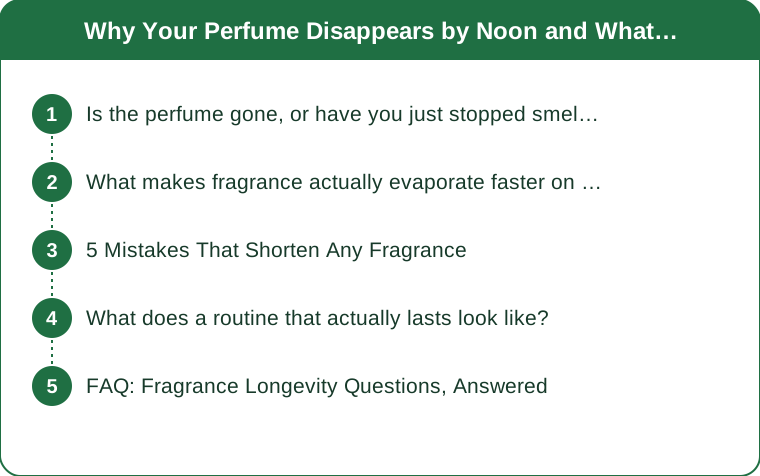
Quick Answer: Two different problems wear the same disguise. The first is olfactory adaptation — your brain files your own fragrance as background within the hour and stops reporting it, even while everyone else smells it clearly. The second is genuine evaporation, accelerated by dry skin, which has no oil layer to hold scent molecules. The fixes are matched: for nose-blindness, stop re-spraying and start trusting time-release placements; for real fade, moisturize before applying, target warm pulse points, and add one fabric placement as your all-day witness. Diagnose first — most people treat the wrong one.
Here is how to tell which problem you have, and the routine that solves both.
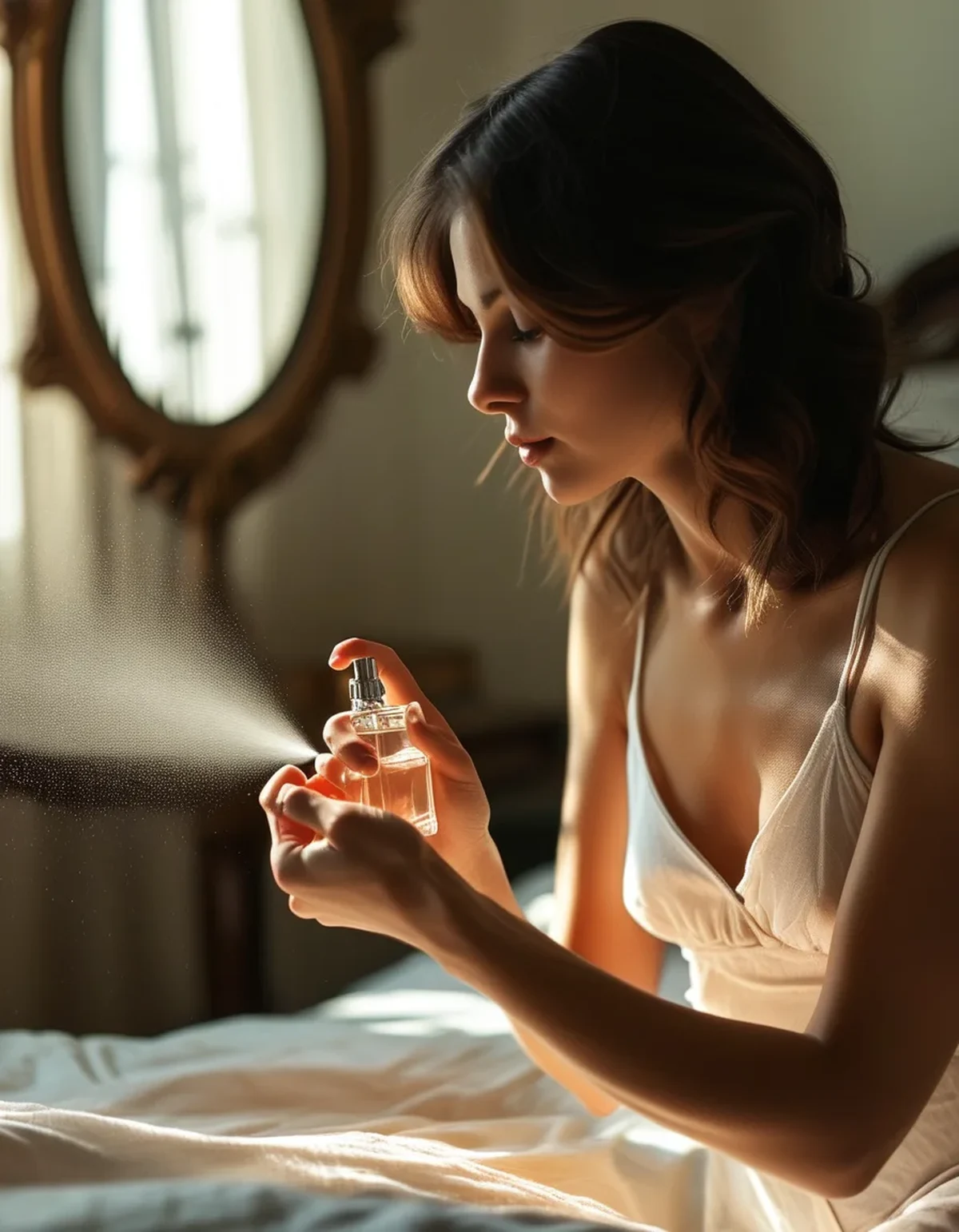
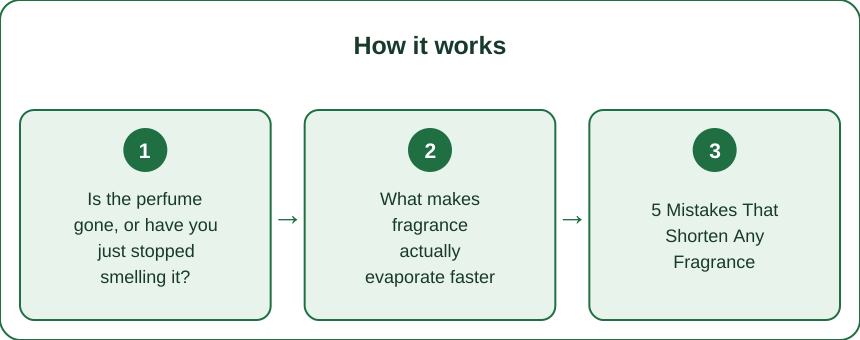
Is the perfume gone, or have you just stopped smelling it?
Usually the second — and there is a clean way to find out.
Your olfactory system is an alarm system, not a monitor. It exists to flag change: new smells, appearing and disappearing, get full reporting. A constant smell — your home, your laundry, your own perfume — gets filed as ambient and dropped from the feed, often within thirty to sixty minutes. The scent is still radiating off your skin at nearly full strength; your brain has simply marked it read. Perfumers call it olfactory adaptation, and it is strongest for exactly the fragrance you wear most.
The test: ask someone, or trust the compliment record. If people comment on your perfume at 2pm on days you stopped smelling it at 10am, you never had a longevity problem — you had a reporting problem. A second test: leave your scarf or jacket in another room overnight, then walk in fresh the next morning. Smelling your own fragrance clearly on the fabric proves the scent survives; your nose was the component that quit.
Why this diagnosis matters: the nose-blind response to re-spray is a spiral. Each top-up raises the dose past what everyone around you finds pleasant, while your adapted nose barely registers the change — the classic heavy-handed fragrance wearer is almost always someone treating adaptation as evaporation. The half-fixes that actually help: change where you smell yourself rather than how much you apply — a spritz on a hair brush or scarf enters your awareness intermittently as you move, reading as new each time. And rotating between two or three fragrances across the week keeps each one novel enough that your own nose stays on the mailing list.
Only once you have ruled adaptation out is it worth treating the skin side — which is real, common, and almost entirely about oil.
What makes fragrance actually evaporate faster on some skin?
Dryness, mostly — with heat, placement, and concentration as accomplices.
Fragrance molecules need something to dissolve into and release from slowly. Skin with a healthy oil layer acts like a slow-release reservoir; dry skin is a hot sidewalk — the scent flashes off in a couple of hours regardless of what you paid for it. This is the single biggest individual difference in fragrance longevity, and it is why the same bottle lasts all day on one friend and vanishes on another by lunch.
The corollary is the cheapest longevity upgrade that exists: moisturize before you spray. An unscented lotion or a whisper of plain oil on the pulse points, allowed a minute to settle, then fragrance on top. On dry skin this routinely doubles wear time — more improvement than upgrading from any eau de toilette to any parfum. In dry late-summer air conditioning, it is the difference between an afternoon scent and a morning memory.
Concentration matters, but less than the label implies. Parfum and eau de parfum carry more aromatic oils than eau de toilette and cologne, and they do last longer — on the same skin. Prepped skin wearing an EDT frequently outlasts dry skin wearing parfum. Buy concentration if you love it; fix the skin either way.
Composition matters too, and citrus is honest about it. Bright top notes — citrus, light florals, anything described as fresh — are chemically small, volatile molecules that evaporate fast by nature; woods, ambers, musks, and vanillas are heavy molecules built to linger. A fresh cologne disappearing in three hours is not failing — it is being citrus. If you want the opening to be the whole day, you want a different base, not a bigger dose.
And the accidental accomplice: rubbing your wrists together after spraying. The friction and warmth accelerate the fragile top notes into the air all at once and mash the scent’s structure — spray and let it dry untouched. It is the most repeated fragrance mistake in the world, inherited hand-me-down style from watching someone else do it.
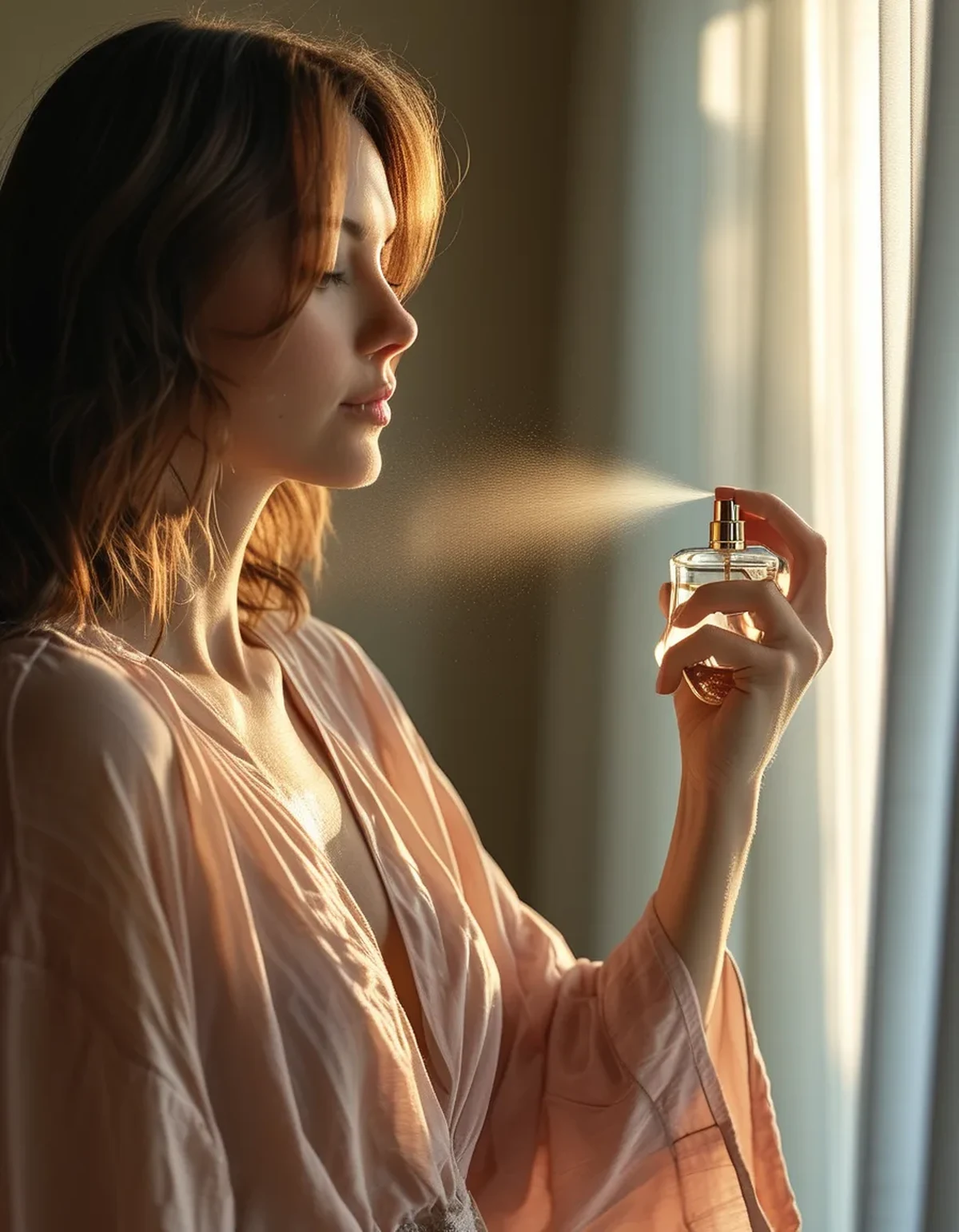
5 Mistakes That Shorten Any Fragrance
Spraying onto dry, bare skin straight out of the shower towel. Post-shower skin feels clean but is often at its most stripped. The order that works: moisturizer, one minute, then fragrance — the shower is an asset only if you re-oil the canvas first.
Wrist-rubbing. Covered above and worth its own entry, because nearly everyone does it. Spray, hover, let dry. That is the whole technique.
Spraying only where you cannot smell it. Wrists and neck warm the scent beautifully for others but sit outside your own sniff radius most of the day — one reason you think it died. Add one placement that crosses your own airspace: chest, collarbone, or a light pass on the hair or brush.
Storing the bottle on a sunny bathroom shelf. Heat, light, and humidity slowly break fragrance down — the vinegary or flat off-smell of an aged bottle is chemistry, not imagination. A drawer or closet doubles a bottle’s honest lifespan; the bathroom windowsill is where perfume goes to retire.
Treating clothing as an afterthought. Fabric holds scent dramatically longer than skin — no oil to metabolize it, no warmth to burn it off. One spray on a scarf, jacket lining, or shirt hem is your all-day proof-of-life. Two cautions: silks and delicates can spot, so test somewhere hidden, and fabric skips the skin-warmth development that makes a fragrance bloom — which is why the answer is skin and fabric, never fabric alone.
What does a routine that actually lasts look like?
Five minutes in the morning, structured around how evaporation actually works.
Step one: canvas. Unscented moisturizer on the spots you intend to spray — inside elbows, chest, base of throat, wrists if you must. One minute to absorb. In August air conditioning or post-sun dryness, this step is doing most of the day’s work.
Step two: placement by job. Two or three warm pulse points project the scent for others — inner elbows are quietly the best of them, warm, protected from washing, and near your own nose when you move. One cooler, fabric-adjacent placement — collarbone under a shirt, or the hem of a scarf — acts as the reservoir, releasing slowly all day. Spray from about six inches; a mist that settles beats a jet that runs.
Step three: the hair pass, correctly. Hair diffuses scent beautifully with every turn of your head, and alcohol sprayed directly on it is drying — so mist the brush and pull it through, or spray a cloud and walk under it. This placement is also your anti-adaptation insurance: it moves in and out of your own awareness, so the fragrance keeps reading as present to you.
Step four: stop. Four to six total sprays of most eau de parfums is a full day for everyone near you. If you cannot smell it two hours in, run the diagnosis — scarf test, honest friend — before adding more. The re-spray belongs in your bag for after workouts or before evening plans, not on a schedule.
Step five: match the fragrance to the season you are in. Heat amplifies projection and burns through top notes faster — the same scent wears bigger and shorter in late summer than it will in October. The traditional summer answer is lighter compositions applied slightly more often; the transitional-season trick is starting the richer autumn bottle now on evenings only, which is exactly when the first cool nights make it read right.
Run this routine for a week and most disappearing-perfume complaints resolve — about half from actual longevity gains, and half from finally being able to perceive what was there all along.
FAQ: Fragrance Longevity Questions, Answered
Does spraying more make it last longer?
Barely. Extra sprays raise the opening volume but the evaporation curve keeps its shape — you get a louder morning, not a longer day, and you risk the adapted-nose overdose spiral. Skin prep and placement move the curve; dose mostly moves the peak.
Is Vaseline on pulse points a real trick?
Real — it is the reservoir principle in its bluntest form: an occlusive layer that slows evaporation. Unscented lotion or a drop of jojoba does the same with less shine and no interference, which is why the moisturize-first step is the refined version of the same physics.
Why does my perfume last on clothes but not on me?
Because fabric does not drink it and body heat does not burn it off — cloth is a passive holder, skin is an active one. That gap is the strongest clue you have dry skin doing the disappearing: feed the skin, and the gap narrows noticeably.
Do fragrance-free days actually reset your nose?
Meaningfully, yes. A day or two off your signature scent clears much of the adaptation, which is why it smells vivid again after a vacation apart. Rotating two or three fragrances achieves the same reset continuously — monogamy is the fastest route to nose-blindness.
TL;DR:
- Diagnose first: if others still smell it after you stop, that is olfactory adaptation, not fade — and re-spraying is the wrong fix.
- Real fade is mostly dry skin: moisturize the spray zones first, and a light EDT on prepped skin outlasts parfum on a parched canvas.
- Placement is strategy — warm pulse points project, one fabric spot holds all day, the hair-brush pass keeps you in your own audience.
- Never rub wrists, store bottles dark and cool, and rotate fragrances to keep your nose honest.
Tomorrow morning: lotion first, six sprays total, one on the scarf. At noon, smell the scarf before you reach for the bottle — it will tell you which problem you actually had.
Keep Reading
This article is for general informational and styling purposes only. Fit, sizing, and product availability may vary.