5 Fragrance Setups for the Weeks Between Summer and Coat Weather
Quick Answer: The problem with transitional weeks is not the fragrance, it is the temperature range within a single day. A scent applied at fourteen degrees behaves differently at twenty-four, and most summer fragrances are built to project in heat while most autumn ones need warmth to open at all. These five setups solve that by changing application - placement, quantity, and layer - rather than by buying anything new.
Five setups. No new bottles.

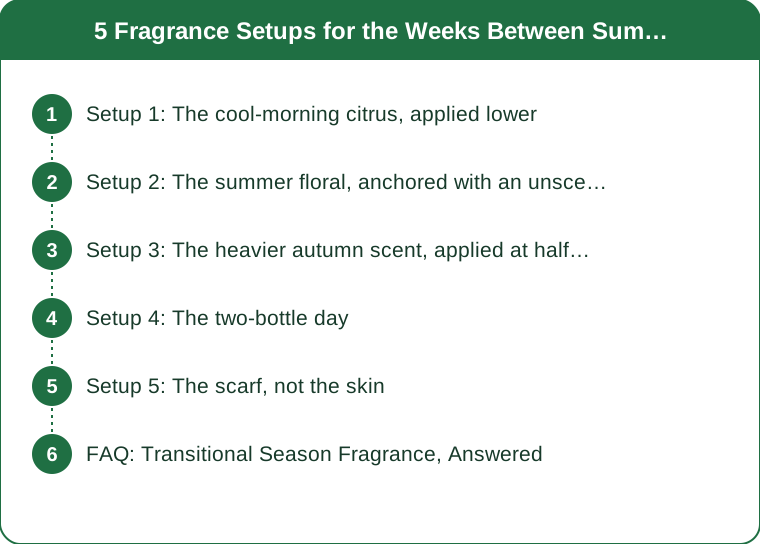
Setup 1: The cool-morning citrus, applied lower
Your summer citrus is not finished - it is simply being applied where there is no longer enough heat to lift it.
Move application from the wrists and neck down to the chest and the inside of the elbows, under a layer of clothing where body heat is retained rather than lost to cool air.
This keeps a bright fragrance readable in the morning without the harsh top-note blast that a warm afternoon produces from the same spray.
Use one more spray than you would in August, since cool air genuinely reduces evaporation and therefore projection.
The effect is a citrus that stays close and personal in the morning and opens naturally as the day warms.
Best for the weeks where mornings are cold and afternoons are not, which is most of this stretch of the year.
Setup 2: The summer floral, anchored with an unscented balm
Light florals disappear fastest in transitional weather because skin is drier and holds less.
A layer of unscented moisturiser or balm applied first gives the fragrance something to bind to and extends wear substantially.
Apply the balm, wait a minute for it to absorb, then spray onto the same area - the order matters more than the product.
Expect noticeably longer wear rather than more projection, which is usually what people actually want from a daytime floral.
Petroleum-based balms work best for longevity but can slightly mute the top notes, so use them on pulse points and not everywhere.
Best for the days you are indoors in heated rooms, where dry air strips a light floral within an hour or two.
Setup 3: The heavier autumn scent, applied at half strength
Your warm amber or woody fragrance is not too heavy for early autumn - you are applying it at winter quantity.
Cut the number of sprays in half and place them on the chest rather than the neck, where the projection radius is smaller.
Warm fragrances open with body heat, so they need less help in a warm room and considerably more outdoors in the cold.
One spray on clothing and one on skin gives a longer, quieter version than two on skin, since fabric holds scent longer and releases it more slowly.
Check it at the two-hour mark rather than immediately - heavy fragrances are routinely over-applied because they read as quiet in the first ten minutes.
Best for cool evenings and days that start cold, where you want presence without a cloud.
Setup 4: The two-bottle day
One fragrance for the morning commute and a different one from the afternoon is how most people who love fragrance actually handle this season.
Keep a small decant or travel spray in a bag and apply the second in the early afternoon rather than trying to make one scent cover a fifteen-degree range.
Choose a pair that shares a note - both with a woody base, or both with a citrus opening - so the transition reads as intentional rather than as a collision.
Apply the second to a different area than the first, since layering on top of a fading scent produces an unpredictable third thing.
Cleansing wipes on the wrists before reapplying solve that entirely if you want a clean break.
Best for long days that start cold and end social, which is much of this period.
Setup 5: The scarf, not the skin
Fabric holds fragrance far longer than skin and releases it slowly rather than in a burst.
A light scarf sprayed the night before carries a soft, consistent scent through the following day with none of the peak-and-fade of skin application.
Spray from a distance and let it dry fully before wearing, and test on an inconspicuous corner first since some fragrances mark pale or delicate fabrics.
Natural fibres hold scent better than synthetics, with wool and silk considerably better than polyester.
This works particularly well with fragrances you find too strong on skin, since fabric application is naturally quieter.
Best for the first cold mornings, where a scarf is in play anyway and skin application is fighting the temperature.
FAQ: Transitional Season Fragrance, Answered
Why does my summer fragrance disappear in cooler weather?
Cool air slows evaporation and dry skin holds less. Move application to warmer covered areas and use a balm underneath.
Should I switch to autumn fragrances straight away?
Not necessarily. Applying a heavier scent at half strength usually works better than waiting for real cold.
Can I layer a summer and an autumn fragrance?
Yes, if they share a note. Apply to different areas rather than on top of each other.
How many sprays in cool weather?
One to two more than in high summer for light fragrances, and half as many for heavy ones. The direction depends on the scent, not the season.
Is spraying clothes a bad idea?
Not inherently, but test an inconspicuous area first - some fragrances mark pale or delicate fabrics. Natural fibres hold scent best.
Why does my fragrance smell different indoors?
Heated indoor air is dry and warm, which speeds evaporation of top notes and pushes the base forward earlier.
TL;DR:
- Transitional weeks fail because of the temperature range within one day, not because your fragrances are wrong for the season.
- Move light fragrances to warm covered areas and add a spray; cut heavy fragrances to half strength and place them lower.
- An unscented balm underneath extends wear on dry skin more reliably than anything else.
- Two bottles across one day works better than forcing one to cover fifteen degrees - pick a pair that shares a note.
- Fabric, especially a scarf, holds scent longer and releases it more evenly than skin.
Change the application before you change the bottle. It solves most of this season.
Keep Reading
This article is for general informational and styling purposes only. Fit, sizing, and product availability may vary.