5 Fabrics That Change How Your Perfume Smells
Quick Answer: Fabric changes fragrance in two ways — how long it holds the scent, and which notes it holds. Natural fibres with texture and porosity, like wool and cotton, grip molecules and release them slowly, so fragrance lasts far longer but smells less bright. Smooth synthetics hold less and can distort scent as they trap body odour alongside it. Skin remains the reference, and everything else is a variation you should choose deliberately.
You wore the same fragrance three days running and it smelled different every day.
You also wore a different jumper each time.

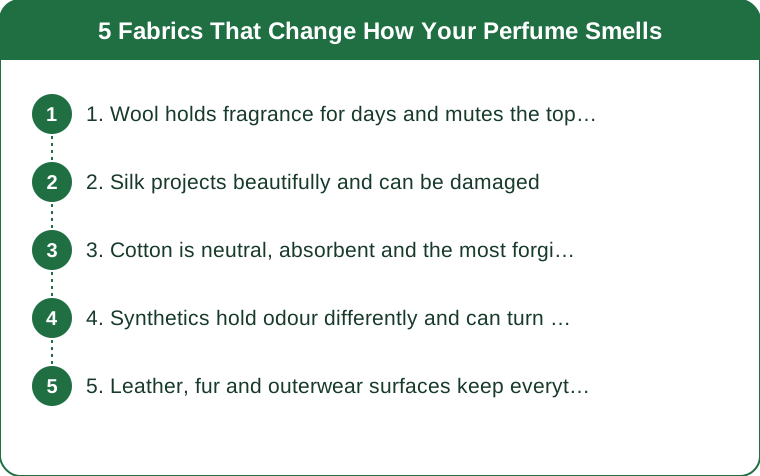
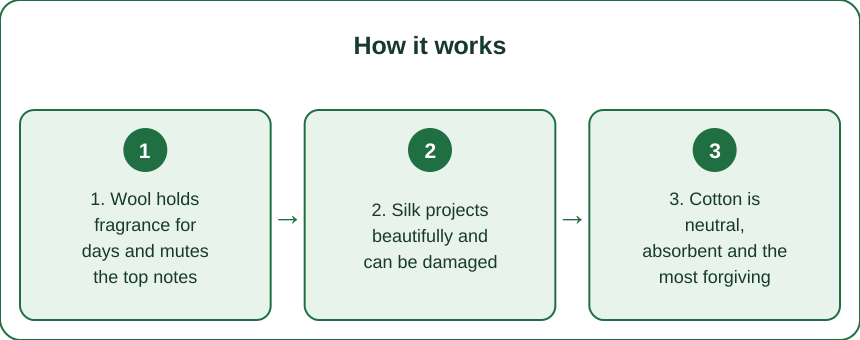
1. Wool holds fragrance for days and mutes the top notes
Wool is the most transformative fabric in an autumn wardrobe and the one most people spray without thinking.
Wool fibres are scaly, porous and highly absorbent, which means they trap aromatic molecules extremely effectively. A fragrance sprayed on a wool coat can be detectable days or even weeks later, long after the same spray on skin has gone.
The trade-off is that wool holds the heavier molecules preferentially. The bright citrus and aromatic top notes evaporate quickly and are barely retained; the base notes — woods, resins, musks, vanilla — are the ones that stay. A fragrance on wool is essentially a base-note version of itself, which is why a scent can smell warmer and heavier on a coat than on skin.
This is genuinely useful in autumn, because base-heavy is what most people want in cold weather anyway. Spraying a scarf or a coat lining rather than skin extends a fragrance dramatically and shifts it in a direction that suits the season.
The caution is that it is close to permanent. Wool does not release fragrance easily, so a coat sprayed with something you later dislike will keep reminding you, and layering a new fragrance over old wool produces a combination rather than a change. Spray the lining or a scarf rather than the outer shell, and give a coat a season to clear before switching.
2. Silk projects beautifully and can be damaged
Silk is the fabric that flatters fragrance most and tolerates it least.
Silk is smooth and lightweight, so it releases scent readily rather than locking it in. A silk scarf carries fragrance with unusual clarity — closer to how it smells on skin than any other fabric — and moves it into the air well as you move.
The problem is that alcohol and oils can stain silk, and the damage is often permanent. Fragrance sprayed directly onto silk can leave marks, particularly on pale colours, and darker fragrances with high oil content are worse.
Spray the air and walk through it, or spray the underside of a hem rather than a visible surface, or scent the skin beneath and let the silk pick it up indirectly. All three work and none risk the fabric.
Silk also holds fragrance for a shorter period than wool — a day or two rather than weeks — which makes it easier to change and less prone to accumulation.
The combination that works well in autumn is a base-heavy fragrance on wool for longevity and a lighter application near silk for projection, which gives you both without over-applying either.

3. Cotton is neutral, absorbent and the most forgiving
Cotton is the workhorse and the safest surface to scent.
Cotton absorbs readily, holds fragrance for a day or so, and does not distort it much. It is porous enough to hold on to a scent and does not selectively grip base notes the way wool does, so a fragrance on cotton smells relatively true.
It also washes clean, which is the practical advantage over everything else on this list. A mistake on a cotton shirt is a laundry cycle away from being resolved, where a mistake on a wool coat is a season.
The caveat is that cotton holds body odour just as readily, and the combination of stale sweat and fragrance is considerably worse than either alone. Fragrance on a not-quite-fresh shirt is the most common cause of a scent smelling wrong on a given day, and it has nothing to do with the fragrance.
Fabric softener interferes, adding its own strong scent that competes with anything you apply. If you wear fragrance regularly, an unscented detergent and no softener will change how your perfume reads more than switching bottles would.
Cotton is where to experiment. It is neutral, it is cheap to get wrong, and it tells you roughly what the fragrance actually smells like on fabric.
4. Synthetics hold odour differently and can turn a scent sour
This is the one that catches people out and it is a real chemical difference rather than a snobbery about natural fibres.
Polyester and similar synthetics are hydrophobic, so they do not absorb water-based sweat well and instead retain the oils and the bacteria that produce odour. This is why technical fabrics develop a persistent smell that survives washing in a way cotton does not.
Fragrance applied over that does not mask it — it combines with it, and the result is frequently unpleasant in a way neither component would be alone. A favourite scent smelling sour or strange on a particular top is usually this, not a change in the fragrance.
Synthetics also hold less fragrance overall, so what you apply projects more strongly early and disappears faster, which produces the impression that a fragrance is not lasting when the fabric is the variable.
Heat makes it worse. A synthetic layer under a coat in a warm indoor space raises skin temperature and increases both fragrance projection and body odour simultaneously, which is precisely the autumn commute situation.
The practical rule: apply fragrance to skin or to a natural fibre, never to activewear or synthetic base layers, and be aware that a synthetic layer nearest the skin will influence everything above it.
5. Leather, fur and outerwear surfaces keep everything
The final category is the one with the longest memory and the least reversibility.
Leather absorbs fragrance deeply and holds it for a very long time, and it also has its own strong scent that interacts with whatever you apply. A leather jacket accumulates every fragrance you have worn near it, and the result over years is a blend nobody chose.
It is also difficult to clean, and alcohol can dry or mark leather finishes. Do not spray fragrance directly onto leather — scent the lining or a scarf worn with it instead.
Faux fur and heavily textured outerwear behave like wool but more so, with an enormous surface area that grips scent and holds it indefinitely.
The general principle across all outerwear: scent what you can wash or replace, and leave the expensive permanent surfaces alone. A scarf is the ideal fragrance carrier for exactly this reason — it sits near the face where projection matters most, it is washable or replaceable, and it can be changed with your mood.
And the honest closing point: skin is still the reference. Fabric changes fragrance in interesting and useful ways, and none of them is what the perfumer designed. If you want to know what a fragrance actually smells like, wear it on skin, and use fabric deliberately when you want the version that lasts all day and sits closer to its base.
TL;DR:
- Wool grips base notes and holds them for weeks — great for autumn longevity, close to permanent, so scent the lining or a scarf rather than the coat.
- Silk projects fragrance beautifully and can be stained by it; spray the air or the skin beneath instead of the fabric.
- Cotton is neutral, holds for about a day and washes clean, but it also holds body odour, which is the usual cause of a scent smelling wrong.
- Synthetics retain odour-causing oils and combine with fragrance rather than carrying it — never scent activewear or synthetic base layers.
- Leather and textured outerwear keep everything forever; scent something washable that sits near the face instead.
Try your usual fragrance on a cotton scarf tomorrow and on skin the day after, and notice how different the same bottle is.
Keep Reading
This article is for general informational and styling purposes only. Fit, sizing, and product availability may vary.