Why the Same Perfume Can Smell Noticeably Different by the Afternoon Without Reapplying
Quick Answer: Your perfume smells different by afternoon because fragrances are built in layers that evaporate at different speeds — light top notes burn off within 15–30 minutes, heart notes carry the middle hours, and heavy base notes are what’s left by 3pm. Body heat and skin oils speed that timeline up. Apply to cooler, lower-oil spots like the inner elbow if you want a slower, more stable scent.
You spray it in the morning and it’s citrus and green and bright. By 3pm the same wrist smells warm, soft, and vaguely like something else entirely.
The bottle didn’t turn. Nothing went wrong. You’re just smelling a later chapter of the same book.
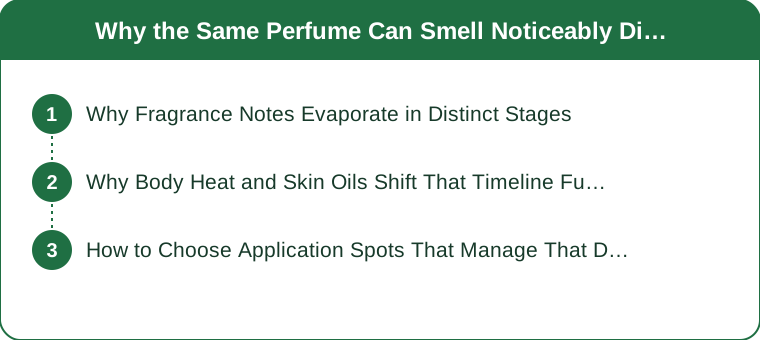
Why Does Perfume Smell Different After a Few Hours?
Because a fragrance isn’t one smell. It’s a sequence, and perfumers build it that way on purpose.
Every composition is structured in three tiers, defined by how quickly the molecules evaporate off warm skin:
- Top notes — the lightest, most volatile molecules. Citrus, bergamot, light herbs, aldehydes. These are what you smell in the first 15–30 minutes, and they’re gone within the hour by design.
- Heart notes — the middle. Florals, spices, green notes. These emerge as the top notes clear and typically carry hours two through four.
- Base notes — the heavyweights. Woods, musk, amber, vanilla, resins. Large, slow-evaporating molecules that can hang on the skin for 6–8 hours or longer.
So the afternoon version of your perfume isn’t a degraded morning version. It’s the base and remaining heart, unmasked — the part that was always there, waiting for the bright stuff to clear out of the way.
This is also why sampling a fragrance on a paper strip at the counter tells you almost nothing about hour four. The strip has no heat and no oil, and it’s mostly showing you the top notes, which are the part you keep for the shortest time.
Does Body Heat Change How Perfume Smells?
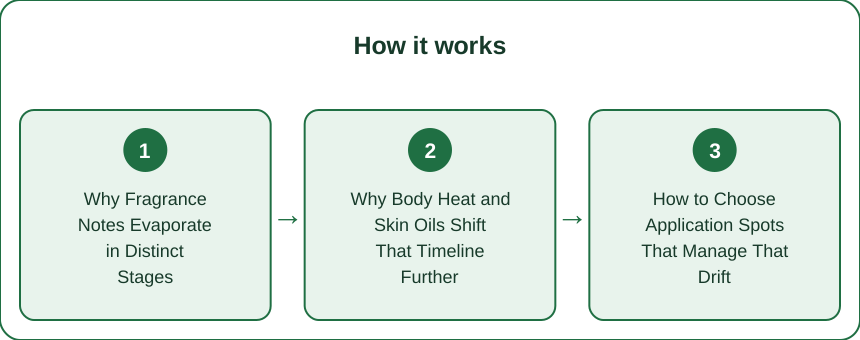
Yes, and more than most people expect — heat is essentially the accelerator pedal on that whole timeline.
Evaporation speeds up as temperature rises. Your body isn’t a uniform 98.6°F on the surface; pulse points where blood vessels run close to the skin — inner wrists, the sides of the neck, behind the ears — run measurably warmer than, say, your inner elbow or the back of your shoulder.
Spray on a hot pulse point and you push the whole sequence forward. Top notes flash off faster, heart notes arrive early, and you land in the base by early afternoon. Add an 85°F day, or a brisk walk, or a workout, and the timeline compresses further.
Skin oil does the second half of the work. Oil holds fragrance molecules and slows their release, which is why the same perfume genuinely lasts longer on oilier skin and fades faster on dry skin. Different skin surfaces across your own body have different oil levels, so a fragrance can legitimately behave differently on your neck than on your forearm on the same day.
Where Should You Apply Perfume for Longer Wear?
Match the application spot to the outcome you want, rather than defaulting to wrists because that’s what everyone does.
For a slower, more stable scent: apply to cooler, lower-heat areas — the inner elbow, the back of the neck under your hair, the center of the chest under a shirt. Less heat means slower evaporation and a more gradual transition between layers.
For maximum projection early on: the classic hot pulse points work exactly as advertised. You’ll get a bigger opening and a shorter overall arc. That’s a fair trade for a two-hour dinner, less so for a workday.
To extend anything by hours: moisturize the skin first. Unscented lotion or even a thin layer of plain balm gives the fragrance oil to bind to. On dry skin, a scent that normally runs 6 hours can fade in 3.
Two habits worth dropping:
- Rubbing your wrists together. The friction generates heat and physically ruptures the top-note structure. Spray and let it dry.
- Spraying onto clothing instead of skin. Fabric doesn’t have the heat gradient that develops a fragrance, so it holds the composition in a flatter, less evolved state — and some oils stain silk. (It does last far longer on wool, which is either a feature or a problem depending on the coat.)
What Nobody Tells You About “Nose Blindness”
Part of the afternoon shift isn’t the perfume at all. It’s you.
Olfactory adaptation is your nose down-regulating its response to a constant smell — usually within 15–20 minutes of exposure. Which means the person wearing the perfume is often the last person to notice what it currently smells like, and the “it disappeared by lunch” complaint is frequently a scent that’s still perfectly detectable to everyone else in the room.
The practical version: if you can’t smell your own fragrance at 2pm, that is not evidence it’s gone. Reapplying based on your own nose is how people end up wearing considerably more perfume than they think they are.
FAQ
How long should a perfume last on skin?
It depends on concentration. An eau de toilette (roughly 5–15% fragrance oil) typically runs 3–5 hours; an eau de parfum (15–20%) commonly 5–8; a pure parfum can go longer still. Dry skin, hot weather, and high-heat application spots all pull those ranges down.
Why does the same perfume smell different on my friend?
Skin pH, oil production, diet, and medication all shift how fragrance molecules release and how quickly. The base notes are usually where the difference shows up most, which is why a scent you love on someone else can read completely differently after an hour on you — and why sampling on your own skin is non-negotiable.
Does perfume expire?
Yes, generally within 3–5 years, faster for citrus-forward fragrances whose light top notes oxidize first. Heat and light accelerate it, so a bottle stored in a bathroom window degrades much faster than one in a closed drawer. A scent that’s gone sharp, sour, or metallic in the opening has usually turned.
TL;DR:
- Fragrance is built in three evaporation tiers: top notes (15–30 min), heart notes (hours 2–4), base notes (6–8+ hours)
- The afternoon smell is the base layer unmasked, not the perfume going bad
- Body heat accelerates the whole sequence; skin oil slows the release and extends it
- Apply to cool, low-oil spots like the inner elbow for stability; hot pulse points for a big, short opening
- Moisturize first, never rub your wrists, and don’t trust your own nose after 20 minutes
Keep Reading
This article is for general informational and styling purposes only. Fit, sizing, and product availability may vary.