Fragrance in a Heatwave: Why Your Perfume Gets Loud in July
Quick Answer: Heat speeds evaporation, so the same two sprays project noticeably further in July than in March — warm skin diffuses fragrance faster and pushes sweet and heavy notes toward cloying. Fix it three ways: rotate to citrus, green, tea, and clean musk families, cut your spray count (one where you used three), and store bottles in the dark and cool — a sunny shelf or a hot car degrades perfume faster than anything else you’ll do to it.
You wore the same perfume you always wear. You used the same number of sprays.
Then you got in an elevator and watched someone’s expression change.
Nothing’s wrong with the fragrance and nothing’s wrong with you. Perfume has a thermostat, and in July it’s turned all the way up.

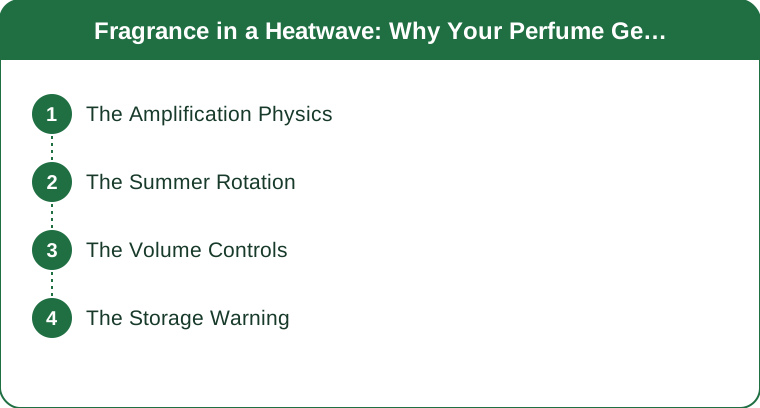
Why does perfume smell stronger in hot weather?
Because fragrance reaches your nose by evaporating, and heat accelerates evaporation.
Warm skin — anything above about 90°F on the surface, which pulse points easily hit in summer — releases aromatic molecules faster and pushes them further from your body. That’s projection, and in summer it’s larger with no change in what you applied.
Two secondary effects come with it:
- Sweet notes turn syrupy. Vanilla, tonka, gourmand accords, and heavy florals amplify disproportionately, going from warm to thick.
- Heavy bases can tip. Oud, amber, resins, and dense woods are designed to sit close in cold air. In heat, they fill a room instead.
The important nuance: summer doesn’t mean the fragrance became worse. It means the volume knob moved without your permission. Your taste doesn’t need to change — the math does.
Which fragrance families work best in summer?
Four categories are essentially built for heat, and one of them was literally invented for it.
Citruses. Bergamot, lemon, grapefruit, neroli. The Mediterranean cologne tradition is a piece of summer technology developed in hot climates for hot climates — it’s light, it’s bright, and it evaporates fast enough that it never accumulates.
Greens and teas. Vetiver, fig leaf, green tea, mint. Cool-reading and low-projection by nature.
Marine and clean musks. Airy, skin-close, and difficult to over-apply. The safest option if you work in close quarters.
The fig and neroli family. Slightly creamy but still bright — a good middle ground for people who find pure citrus too thin.
Your winter loves aren’t retired, they’re rotated. Rotating a fragrance wardrobe by season is the system working, not a limitation. The orientals come back in October and smell better for having been away.

How do you wear a heavy fragrance in summer anyway?
Three volume controls, in order of how much they help.
- Fewer sprays. One where three lived. This is unglamorous and it’s most of the solution — projection scales with quantity, and summer already multiplied it for you.
- Apply to clothing or hair-adjacent areas instead of hot pulse points. Fabric releases scent much more slowly than warm skin does, so a spray on a shirt collar or scarf gives you a quieter, longer trail. (Test on an inconspicuous spot first — some fragrances stain silk and pale fabrics.)
- Use the lotion or body-oil version. The quietest format there is. Scented body lotion sits almost entirely on you rather than around you, which is exactly what a close-quarters July calls for.
A practical benchmark: if you can smell yourself continuously while sitting still, everyone within about six feet can smell you too. Perfume is meant to be discovered, not announced.

Where should you store perfume in summer?
Somewhere dark and cool — and this matters more than any application decision you’ll make.
Heat and UV light break down aromatic compounds. Degraded perfume turns sour or flat, top notes disappear first, and the color often darkens visibly. It’s irreversible.
The two worst places, both extremely common:
- A sunny bathroom or vanity shelf. Direct light plus the humidity and temperature swings of a bathroom is the most damaging combination in the house.
- A car glovebox. Interior temperatures in a parked car regularly exceed 130°F in summer. A bottle left there over a weekend can be noticeably changed.
Store bottles in a closet, a drawer, or the box they came in. Keep the caps on — evaporation through an open sprayer is slow but real. Stored properly, most eau de parfums hold up for 3 to 5 years; stored on a sunny shelf, some shift within a single summer.
If you have a fragrance you rarely wear and want to protect, a refrigerator works well, though it’s overkill for a bottle you’re using regularly.
Myth vs Fact
Myth: Perfume doesn’t last in summer, so you should apply more. Fact: It projects further and burns off faster. Applying more increases the projection problem without fixing the longevity one — reapplying a small amount later works better.
Myth: Rubbing your wrists together helps it develop. Fact: Friction and heat crush the top notes and speed evaporation. Spray and let it dry.
Myth: Expensive fragrances are immune to heat. Fact: Price has nothing to do with it. Composition does — a $300 amber will overwhelm a July elevator faster than a $40 citrus.
Myth: Fragrance goes on pulse points because it “activates” there. Fact: Pulse points are warm, which is exactly why they over-project in summer. Cooler placement is the better summer choice.
Myth: Perfume doesn’t expire. Fact: It does, and heat and light accelerate it dramatically. Most fragrances hold 3–5 years stored properly, and much less on a sunny shelf.
FAQ
What scents are best for hot weather?
Citrus, green, tea, marine, and clean musk families perform best because they’re light, they sit close to skin, and they don’t amplify unpleasantly as temperature rises. Traditional colognes were developed specifically for hot Mediterranean climates and remain among the most reliable summer options. Heavy gourmands, ambers, and oud-based fragrances are the ones most likely to overwhelm.
How many sprays of perfume should you use in summer?
Roughly a third to half of your cold-weather amount — if you normally use three sprays, try one. Warm skin projects further, so the same quantity reaches noticeably more people. A useful check is whether you can smell yourself continuously while sitting still; if you can, it’s likely too much for anyone nearby.
Does heat ruin perfume?
Yes, over time and permanently. Heat and UV light break down aromatic compounds, causing top notes to fade, the scent to turn sour or flat, and the liquid to darken. A sunny bathroom shelf and a car glovebox are the two most common places this happens — storing bottles in a closet or their original box prevents nearly all of it.
TL;DR:
- Heat speeds evaporation, so the same sprays project further and sweet notes turn syrupy.
- Rotate to citrus, green and tea, marine, and clean musk families for summer.
- To keep a heavy favorite: fewer sprays, apply to fabric rather than hot pulse points, or use the lotion version.
- One spray where three lived is most of the fix.
- Store bottles dark and cool — a sunny shelf or hot car degrades perfume permanently.
- Properly stored, most fragrances hold 3–5 years; on a windowsill, much less.
Keep Reading
This article is for general informational and styling purposes only. Fit, sizing, and product availability may vary.