5 Fragrance Layering Mistakes Quietly Muddying a Scent You Actually Like
Quick Answer: The most common fragrance layering mistake is combining scents with clashing dominant notes (like a heavy vanilla gourmand with a sharp citrus) or applying too many sprays of each, which overwhelms rather than complements — successful layering usually means one fragrance acts as a base and the other as a lighter accent, not two equally strong scents competing.
Two fragrances you individually love, worn together, sometimes smell like neither. That’s a layering mistake, not a sign the fragrances themselves were wrong for you.

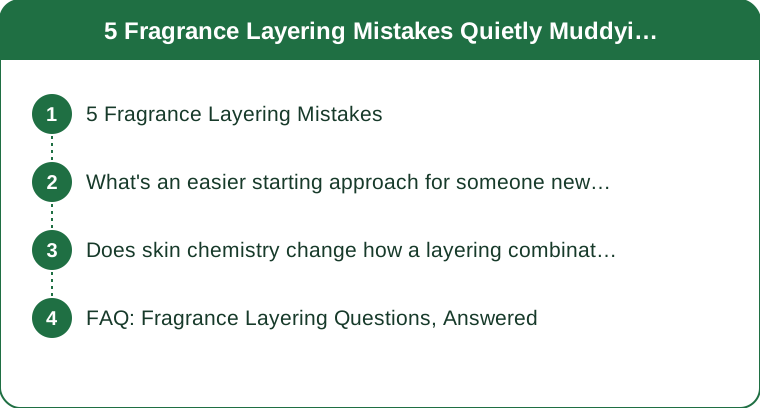
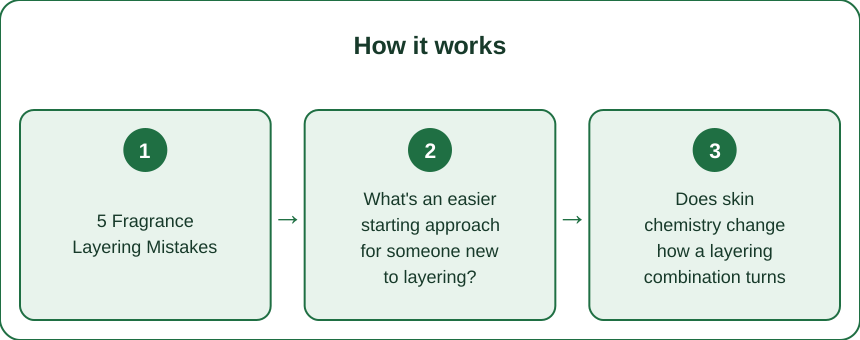
5 Fragrance Layering Mistakes
1. Combining two dominant, complex fragrances at equal strength. Two fragrances that are both loud and multi-layered on their own tend to compete rather than blend — layering works better when one fragrance is simpler or lighter, acting as a supporting note rather than a second lead.
2. Ignoring note families that clash structurally. Heavy gourmand scents (vanilla, caramel, chocolate) and sharp aquatic or citrus scents often clash rather than combine smoothly — pairing within or near compatible families (warm with warm, fresh with fresh) generally layers more successfully than pairing opposites.
3. Applying full strength of both fragrances. Using a normal full application of two fragrances essentially doubles the total scent load — reducing to 1-2 sprays of each, rather than a full application of both, keeps the combination from becoming overwhelming.
4. Applying both to the same exact spot. Layering in the same location intensifies the clash; applying one to pulse points and the other to clothing or hair, or spacing them to different body areas, lets both develop with a bit more separation rather than colliding immediately.
5. Not testing the combination before a full day of wear. A combination can smell fine in the first ten minutes and shift into something unpleasant an hour later as top notes fade and the base notes of both fragrances interact — testing on skin for at least an hour before committing to a full application avoids an all-day regret.
What’s an easier starting approach for someone new to layering?
Pick one fragrance as the clear base (usually the one with more depth or a stronger dry-down) and use a genuinely light, simple scent as the accent — something like a single-note vanilla or amber oil layered under a more complex fragrance tends to work more reliably for beginners than combining two complete, complex fragrances.

Does skin chemistry change how a layering combination turns out?
Yes, meaningfully — the same two fragrances can layer well on one person’s skin and clash on another’s, since skin pH and oil levels affect how notes develop. This is part of why testing a specific combination on your own skin matters more than following someone else’s exact layering recipe.
FAQ: Fragrance Layering Questions, Answered
Is it better to layer fragrances from the same brand or different brands?
Either can work — brand matching isn’t the deciding factor, note compatibility is. Some of the most successful layering combinations mix brands entirely.
Should lotion or oil layering be treated differently from spray layering?
Unscented or lightly scented body lotion as a base layer generally helps a fragrance last longer and blend more smoothly than spraying two fragrances directly onto skin or clothing.
How can I tell if a layering combination is working versus just muddy?
A successful layer usually reads as one new, cohesive scent rather than two identifiable separate ones fighting for attention — if you can clearly smell both fragrances as distinct and competing after the first ten minutes, that combination likely needs adjusting.
TL;DR:
- Combining two equally dominant fragrances tends to clash rather than blend
- One fragrance as base, one lighter as accent, generally layers more successfully
- Reducing spray count (1-2 each) prevents an overwhelming total scent load
- Test any new combination for at least an hour before committing to full-day wear
Layering isn’t about combining two favorites at full strength — it’s about giving one room to lead while the other quietly supports it.
Keep Reading
This article is for general informational and styling purposes only. Fit, sizing, and product availability may vary.