Five Ways to Shift a Summer Fragrance Into Autumn Without Buying Anything
Quick Answer: Fragrance performance depends on skin temperature and ambient humidity, both of which drop in autumn. The same perfume projects less, lasts differently, and reads as thinner. You can adapt it without a new bottle by changing where you apply it, what you apply it over, how much you use, and what you layer underneath — all of which change how the same molecules behave.
The scent that felt perfect in July smells strangely faint and slightly sharp now. You have not developed nose blindness overnight, and the bottle has not gone off.
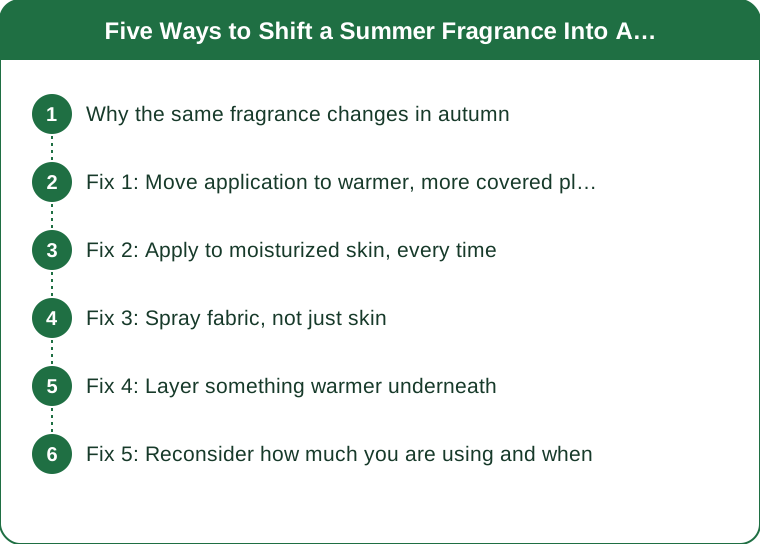
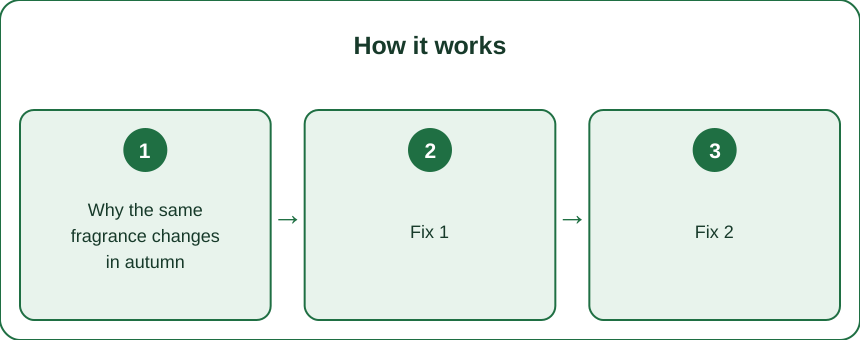
Why the same fragrance changes in autumn
Two environmental variables do most of it.
Skin temperature drops. Fragrance projects by evaporating off your skin, and evaporation rate depends on heat. Cooler skin means slower evaporation, which means less projection — the scent stays close to you instead of filling the space around you. It is not weaker; it is quieter.
Humidity drops. Moisture in the air carries scent molecules. In dry autumn air, fragrance travels less and dissipates faster once it does.
The combined result is a fragrance that reads as thin and short. Light citrus and aquatic summer scents suffer most, because they are built from volatile top notes that were relying on warm skin and humid air to perform at all.
The good news is that the same physics gives you levers. Every fix below is about restoring heat, moisture, or a surface that holds the scent longer — and none of them requires a different bottle.
Fix 1: Move application to warmer, more covered places
Wrists are the default and the worst choice in cool weather. They are exposed to air, they cool quickly, and in autumn they spend most of the day under a sleeve being rubbed by fabric.
Apply to places that stay warm and covered: the base of the throat where a collar sits, behind the ears, the inner elbow, the back of the neck, and the upper chest. These retain body heat and stay insulated by clothing, which keeps evaporation going at a summer-like rate.
The back of the neck is particularly effective in autumn and rarely used. It is warm, it is covered by hair or a collar, and it releases scent upward as you move — which is exactly the projection you lost.
One spray in a warm covered spot outperforms three on exposed wrists, which is the reverse of the usual advice and specific to cool weather.
Fix 2: Apply to moisturized skin, every time
This is the single largest lever and the most frequently skipped.
Fragrance needs something to bind to. Dry skin — and autumn skin is meaningfully drier than summer skin — gives the molecules nothing to hold onto, so they flash off quickly.
Apply an unscented moisturizer or a plain oil first, let it absorb for a minute, then spray. The difference in longevity is substantial, often several hours on a fragrance that was fading by lunchtime.
Unscented matters. A scented body lotion competes with the fragrance and usually wins in the first hour, producing a muddled result. Plain jojoba or almond oil, or a fragrance-free lotion, works best.
This fix alone often solves the entire problem for people whose complaint is that the scent disappears within two hours in cool weather.
Fix 3: Spray fabric, not just skin
Fabric holds fragrance far longer than skin because it does not absorb, metabolize, or shed it. A scarf sprayed once in the morning is still noticeable at the end of the day, long after the same spray on skin has gone.
In autumn this is unusually convenient, because you are wearing more fabric. A scarf, a coat lining, a sweater collar, and the inside of a hat are all available surfaces that did not exist in July.
The caution: some fragrances stain, particularly darker ones with high concentrations of oils, and delicate fabrics like silk are the highest risk. Test on an inside seam first, spray from a greater distance than you would on skin, and let it dry before wearing.
A scarf is the ideal candidate — washable, close to the face, and worn every day for the next several months.
Fix 4: Layer something warmer underneath
You can shift the character of a summer fragrance without replacing it by putting a warmer base under it.
An unscented base is fix 2. A lightly scented warm base is fix 4. A plain vanilla or sandalwood body oil, a musky unscented-adjacent lotion, or a simple warm-toned body cream under a citrus or aquatic fragrance gives the top notes something substantial to sit on.
What happens in practice: the bright top notes still arrive first, but instead of evaporating into nothing, they resolve into something warmer. You have effectively given your summer scent an autumn base, which is exactly what fragrance houses do when they release a warmer flanker of a summer release.
Keep the base simple. Anything with a complex scent profile of its own will fight rather than support. One note — vanilla, sandalwood, musk, or a soft amber — is the goal.
Fix 5: Reconsider how much you are using and when
Two adjustments in opposite directions, and which one you need depends on the fragrance.
For light citrus and aquatic scents: use more, and reapply once. These are built from volatile molecules that need volume to register in cool dry air. Two sprays in the morning and one in the early afternoon is reasonable, and reapplying is not a failure.
For anything with a heavy base: use less. Cooler air is less forgiving of heavy fragrance in enclosed spaces, and indoor environments — offices, transit, restaurants — are where you now spend most of your day. What read as generous outdoors in summer reads as overwhelming in a heated room.
Apply immediately after showering, while skin is still warm and slightly damp. Warm skin is the condition fragrance was formulated for, and the ten-minute window after a shower is the best application moment of the day, particularly in autumn.
And the honest verdict on the whole exercise: some summer fragrances genuinely will not translate. A very light aquatic or a sheer citrus is built around conditions that no longer exist, and no amount of application technique makes it read as autumnal. Those are worth retiring until May rather than fighting — but the majority of summer scents, particularly anything with a floral, woody, or musky base, adapt fine with the four fixes above.
TL;DR:
- Cooler skin and drier air reduce projection and longevity — the fragrance is quieter, not weaker
- Apply to warm covered places like the throat, inner elbow, and back of the neck instead of exposed wrists
- Moisturize first with something unscented; this is the biggest single improvement in longevity
- Spray a scarf, layer a simple warm base underneath, and apply on warm skin right after a shower
Most of the disappointment with a summer fragrance in autumn is an application problem rather than a fragrance problem, and the fixes cost nothing except the minute it takes to moisturize first.
Keep Reading
This article is for general informational and styling purposes only. Fit, sizing, and product availability may vary.