Five Moments That Decide Whether Your Fall Fragrance Works
Quick Answer: Judge a fall fragrance by five moments: the first ten minutes, the commute in outerwear, the warm indoor room, the late afternoon fade, and the evening close. Cold air slows projection and heavy fabrics trap and release scent unpredictably, which is why summer favorites so often read wrong in October.
You wore it all summer and loved it. It is October and it smells thin, or sharp, or somehow like it belongs to someone else.
The formula has not changed and neither has your nose.
The five moments where a fragrance actually gets judged have all changed at once.
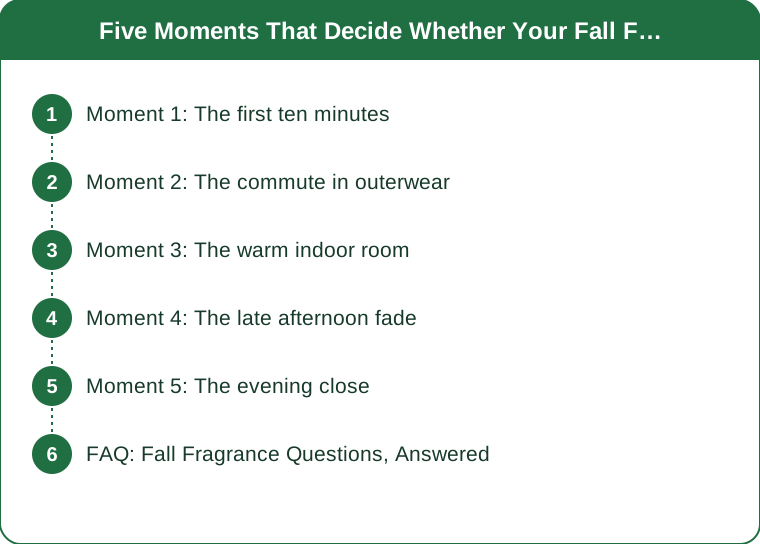
Moment 1: The first ten minutes
Cold skin releases fragrance more slowly than warm skin, and in autumn you are applying to skin that has been under a duvet rather than skin at summer ambient temperature.
The practical effect is that the opening is quieter and shorter than you are used to. A citrus or aldehydic top note that was bright and obvious in July can be almost undetectable in an October bedroom, which is why people reach for a second spray and end up overapplied by hour two.
The fix is placement rather than quantity. Apply to genuinely warm points — the inner elbow, behind the knee if you are wearing tights, the base of the throat under a collar rather than the side of the neck exposed to air.
And apply before you dress rather than after. Fragrance on skin under fabric develops properly; fragrance sprayed over a finished outfit sits on the surface of your clothes and behaves like an air freshener.
Moment 2: The commute in outerwear
This is where summer fragrances most often fail, and almost nobody tests for it.
A coat, a scarf, and a wool layer create a warm, enclosed space around your neck and chest. Scent accumulates in that space over twenty minutes and then releases in a concentrated burst every time you open the coat.
Fragrances with heavy base notes — amber, oud, heavy musks, gourmand vanillas — become genuinely overwhelming under this effect. Fragrances built around fresh top notes lose almost everything, because the volatile molecules that carried them dissipate into fabric rather than reaching anyone.
What survives are compositions with strong mid-range presence: woods, spices, soft florals with real body, and iris or violet structures. This is not fashion — it is a straightforward consequence of which molecular weights survive being trapped in wool for twenty minutes and then released.
Test this deliberately. Wear the scent under your actual coat for half an hour before committing to it for the season.
Moment 3: The warm indoor room
You arrive, remove the coat, and the fragrance that had been accumulating now meets a room at 21C.
This is the projection spike, and it is the single most common source of the feeling that you have overapplied. You have not necessarily overapplied — you have moved from a cold environment where the scent was suppressed to a warm one where three hours of trapped material releases in about ninety seconds.
The adjustment is to reduce application rather than to change fragrance. Two sprays in autumn projects roughly like three did in summer once the coat comes off, and most people do not adjust down.
It is also why heavy scents that seem perfectly reasonable outdoors become a problem in an office or a small meeting room. If you are wearing something with real weight, apply it to a lower point — the inner elbow rather than the throat — so the release is less concentrated at head height.
Moment 4: The late afternoon fade
Autumn fragrances need to be judged at hour six, not hour one, because that is where the seasonal difference is largest.
Dry indoor heating air accelerates evaporation from skin. Once the heating comes on — usually a few weeks after the temperature actually drops — fragrance longevity falls noticeably, and a scent that lasted eight hours in September may be gone by four in November.
The response is not more product. It is moisturized skin, which holds fragrance measurably longer than dry skin, and a fragrance with genuine base-note structure rather than one that lives in its top notes.
The unscented-moisturizer-first step is the highest-return habit in autumn fragrance wearing, and it costs thirty seconds. Skin that has been through a summer of sun and is now meeting dry heated air is exactly the surface that struggles to hold scent.
Moment 5: The evening close
The last moment that matters is the one where you notice it again — the point in the evening where you catch your own fragrance and either like it or do not.
You will have gone nose-blind to the top and mid notes hours ago, so this is entirely a judgment on the base. If you dislike a fragrance’s drydown, you will dislike wearing it, regardless of how good the opening was at the counter.
This is where autumn favors different structures than summer. Warm bases — sandalwood, tonka, benzoin, soft leathers, dry woods — read as comforting against cold air and heavy fabric. The clean musks and marine bases that felt fresh in July can read as cold and slightly institutional in November.
Test for this specifically before buying: wear the sample for a full day and form your opinion at 8 p.m. The drydown is the fragrance you actually live with; the opening is the one you buy.
FAQ: Fall Fragrance Questions, Answered
Should I use a completely different fragrance in autumn?
Not necessarily. Many summer scents work in autumn with lighter application and better placement. Test yours through the five moments before replacing it — the problem is often application, not composition.
How many sprays is right in cold weather?
Generally one fewer than your summer number, applied lower on the body. The coat effect concentrates whatever you apply, so autumn overapplication is easier than it feels.
Does fragrance really last less time in winter?
On skin, yes, largely because of dry heated indoor air. On fabric it lasts considerably longer, which is why scarves and coats hold a scent for days and are worth spraying deliberately if you want longevity.
TL;DR:
- Judge a fall fragrance across five moments, not at the counter: opening, commute, warm room, late fade, evening close.
- Cold skin mutes the opening — fix it with placement on warm points, not with extra sprays.
- Outerwear traps and then releases scent in a burst, so apply one spray fewer and lower on the body.
- Moisturize first; dry heated air is what kills longevity, not the fragrance.
- Buy on the drydown, because that is the part you actually live with.
A fragrance that stopped working in October did not go bad. It ran into a coat, a heated room, and dry air, all of which change how the same molecules behave — and most of the time the fix is where and how much rather than what.
Keep Reading
This article is for general informational and styling purposes only. Fit, sizing, and product availability may vary.