5 Ways to Wear One Fragrance Through a Transitional Week
Quick Answer: You do not need a summer fragrance and an autumn fragrance to handle a transitional week. Application method changes how a scent projects and which notes dominate — the same fragrance applied to hair reads lighter and more diffusive, applied to a wool layer reads warmer and lasts longer, and applied to warm pulse points reads brighter and burns off faster. Five methods, one bottle, five genuinely different results.
Here is the week, laid out.
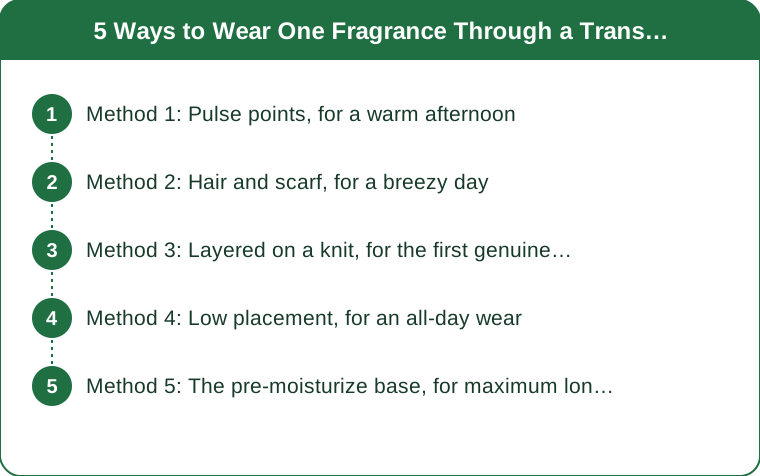
Method 1: Pulse points, for a warm afternoon
The classic application, and the one best suited to the warmest day in a transitional week.
Applying to the inner wrists, the base of the throat, and behind the ears puts fragrance where blood flows close to the surface. Body heat volatilizes the top notes quickly, which produces a bright, immediate, expressive opening.
On a warm day that is exactly right. The heat does the work of projection for you, and the citrus, green, and aldehyde notes at the top of most fragrances read fresh rather than heavy.
The trade-off is longevity. Heat that accelerates projection also accelerates depletion, so a pulse point application on a warm day may be noticeably faded by mid-afternoon.
Use this on: the warmest day of the week, when you want the fragrance to be noticeable immediately and you do not mind reapplying.
Do not do this: rub your wrists together. The friction and heat break down the top notes and distort the intended development. Spray and let it settle.
A quantity note for warm days: less than you think. Heat amplifies projection, so the amount that reads pleasant in a cool room reads loud in a warm one.
Method 2: Hair and scarf, for a breezy day
The most underrated application, and the one that suits a windy, cooler day best.
Hair holds fragrance well and releases it with movement. Every time you turn your head, a small amount of scent is released, which produces a soft, intermittent trail rather than constant projection.
Hair also runs slightly cooler than pulse points, so the development is slower and the middle notes get more time to show.
The technique matters. Do not spray directly onto hair — the alcohol content is drying, especially on color-treated hair. Instead, mist into the air and walk through it, or spray onto a brush and run it through, or apply to a scarf.
The scarf version is genuinely the best of both on a transitional day. Fabric holds fragrance far longer than skin — sometimes for days — and a scarf sits close to your face, which is where you want a soft scent to be perceptible.
Use this on: a breezy, cooler day when you want a subtle trail rather than a statement, or any day you are wearing a scarf anyway.
Watch out for: fragrance staining on silk or light-colored fabrics. Test on a hem first, and spray from further away than you would on skin.
Method 3: Layered on a knit, for the first genuinely cool morning
Wool and knitwear change a fragrance more than any other application surface, and the change is toward warmth.
Textured natural fibers hold fragrance in their structure and release it very slowly. Because the release is slow and there is no body heat driving off the top notes, what you smell over hours is disproportionately the base — the woods, resins, musks, and vanillas.
The practical result is that the same fragrance applied to a wool sweater reads warmer, deeper, and cozier than the same fragrance on skin. A summery scent can be made to work well into autumn with nothing more than this change.
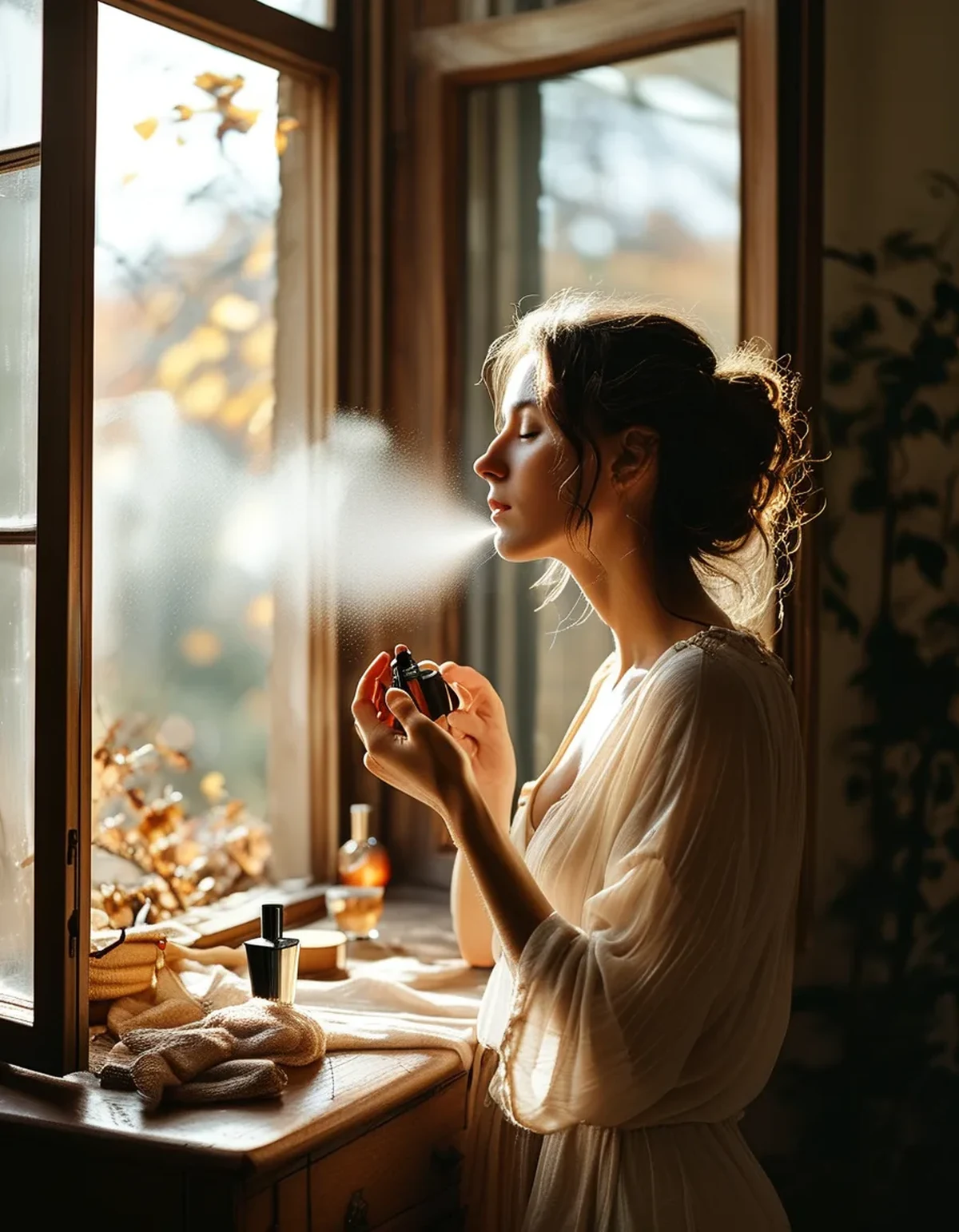
Application: two spritzes onto the inside of the garment, at the chest or the collar, from about eight inches away. Let it dry fully before wearing.
Use this on: the first genuinely cool morning of the week, or any day you want the fragrance present but quiet.
Watch out for: oils in some fragrances can mark delicate fabrics, and knits hold scent for a long time, so you are committing that sweater for a while. Apply to the inside, and do not layer a second fragrance onto a garment that already holds one — the result is muddy rather than complex.
Method 4: Low placement, for an all-day wear
Applying below the neck changes the experience entirely, and it solves the problem of a fragrance you love that becomes tiring by lunchtime.
Fragrance rises. Applied to the lower body — the back of the knees, the ankles, the inner elbows — the scent travels upward through the day, producing a gradual, gentle presence rather than an immediate cloud.
This also addresses nose blindness. When fragrance sits right under your nose, you stop perceiving it within about twenty minutes while everyone else still does. Applied lower, the concentration reaching your own nose is lower and more variable, so you continue to notice it intermittently.
It is also the most forgiving method for a shared office or a small space, where a pulse point application of a strong fragrance can be more than the room wants.
Use this on: long days, workdays in close quarters, or with any fragrance you find beautiful but overwhelming at full strength.
Combine it with: one pulse point application if you want an immediate opening plus the long tail. The behind-the-knees plus one wrist combination is the most versatile in this whole list.
One practical detail: this method works considerably better with tights or trousers than with bare legs, which makes it increasingly useful over the next few weeks.
Method 5: The pre-moisturize base, for maximum longevity
Not a placement change but a preparation change, and it makes more difference than switching fragrances.
Fragrance molecules bind to oil, and dry skin holds them poorly. Applying to well-moisturized skin can substantially extend how long a fragrance lasts, because the oils on your skin give the molecules something to hold to rather than evaporating off a dry surface.
The effect is largest on people with naturally dry skin, who are also the people most likely to complain that fragrance disappears on them within an hour. It is often not the fragrance.
Technique: apply an unscented moisturizer or a plain oil to the area, let it absorb for a minute, then apply the fragrance. Unscented matters — a strongly scented body lotion will fight with what you put on top.
A thin layer of plain petroleum jelly on a pulse point before spraying is the extreme version, and it works remarkably well for an evening when you want longevity.
Use this on: the day of the week you most need the fragrance to last — an evening out, a long day, a special occasion.
Seasonal relevance: as humidity drops through autumn, skin gets drier and fragrances start disappearing faster than they did in summer. If your signature scent seems to have gotten weaker recently, your skin changed, not the formula. This method is the fix, and it is the most useful thing on this list for the next three months.
TL;DR:
- Pulse points on the warmest day for a bright, immediate opening — and use less than in cool weather.
- Hair or a scarf on a breezy day for a soft, intermittent trail; never spray directly onto hair.
- Knitwear pulls a fragrance toward its base notes, which turns a summer scent into an autumn one.
- Low placement gives all-day gradual presence and prevents nose blindness; moisturized skin holds fragrance far longer than dry.
Try the knit method on the first cool morning. It is the closest thing to owning a second bottle.
Keep Reading
This article is for general informational and styling purposes only. Fit, sizing, and product availability may vary.