5 Ways a Fragrance Changes Between the Store and Your Third Wear
Quick Answer: Five things change between the counter and your bathroom: what you smelled it on, how long you gave it, what else was in the air, what your skin did to it, and what your nose did after repeated exposure. All five are real and none of them mean you chose badly.
It smelled extraordinary in the shop. At home it’s fine. By the third wear you can barely detect it. Here’s each mechanism, what it does, and what actually helps.
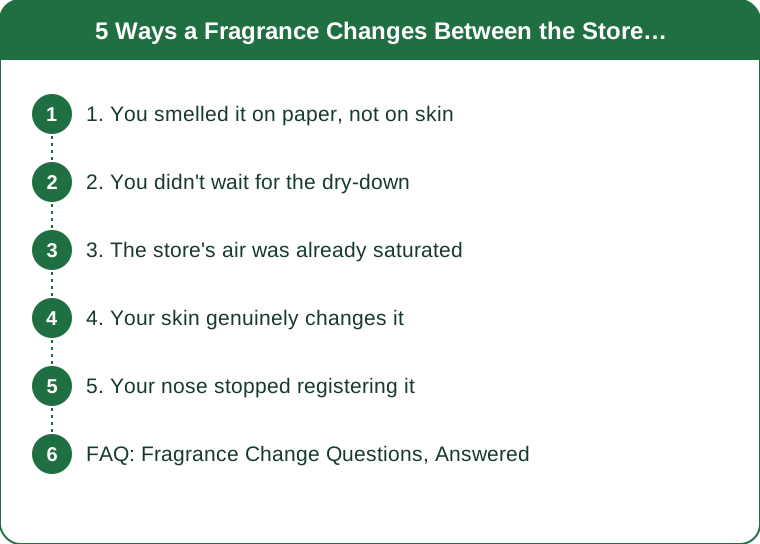
1. You smelled it on paper, not on skin
The most consequential difference, and the one that happens first.
A test strip has no temperature, no oils, no moisture, and no pH. It presents the fragrance’s composition without any of the interaction that happens on a body. Skin changes the evaporation rate of every component, and it changes them unequally — light citrus and aldehydes flash off faster on warm skin, while heavier base notes linger longer.
The practical result is that a fragrance that reads bright and complex on paper can read considerably heavier and simpler on skin.
What to do about it: always test on skin, and specifically on the inside of the wrist or the inner elbow. Test strips are useful for narrowing a shortlist from twelve to three; they’re not useful for the final decision.
2. You didn’t wait for the dry-down
Fragrance unfolds in stages, and the stage you smell in a store is the least representative one.
Top notes last roughly 15 minutes. They’re the most volatile components — citrus, light florals, fresh green notes — and they’re deliberately designed to make an immediate impression.
Heart notes emerge over the next hour or two.
Base notes take hold after two to three hours and are what you’ll actually be wearing for most of the day.
Buying on the top notes is buying the trailer rather than the film. Anything you’ll wear regularly should be assessed at the three-hour mark, which means taking a sample home or wearing it out of the store and deciding later.
The specific trap: the fragrances with the most striking openings often have the most ordinary dry-downs, because a dramatic top note is what sells at a counter.
3. The store’s air was already saturated
Fragrance counters contain dozens of scents in the air simultaneously. Your nose isn’t evaluating one perfume — it’s evaluating one perfume against a background of everything else in the room.
This produces two effects. Contrast, where a scent seems more distinctive than it is because it differs from the ambient mix. And partial fatigue, where your olfactory receptors are already partly saturated, so you perceive less nuance and often reach for something stronger than you’d otherwise choose.
This is a large part of why people consistently buy heavier fragrances than they end up wanting. In a saturated environment, subtlety doesn’t register.
What helps: test no more than three fragrances in a visit, leave the store between tests, and if you can, smell something neutral — your own sleeve works better than coffee beans, which are largely a myth.

4. Your skin genuinely changes it
Skin chemistry is real, though it’s often described more mystically than it deserves.
Skin pH varies between people and affects how certain molecules behave. More acidic skin tends to accelerate the breakdown of some components.
Skin oil holds fragrance longer. This is the main reason perfume lasts noticeably longer on some people — oilier skin gives the molecules something to bind to, while dry skin lets them evaporate.
Skin temperature drives volatility directly. Warmer skin projects more and burns through the composition faster.
Diet, medication, and hormonal changes all shift skin chemistry over time, which is why a signature scent can genuinely stop working after years of reliability.
The practical fix for dry skin: apply an unscented moisturizer first. It gives the fragrance something to hold onto and can extend longevity substantially — often the difference between two hours and six.
5. Your nose stopped registering it
By the third wear, the most likely explanation for it disappeared is that it didn’t.
Olfactory adaptation means receptors reduce their response to a continuously present stimulus. It’s fast — often within 15-30 minutes — and it’s specific to the molecules you’re exposed to. Other people still smell it perfectly.
This is why people gradually apply more, which is the most common cause of over-application. You’ve stopped detecting it; nobody else has.
How to check: ask someone. Or leave the room for ten minutes and come back — you’ll catch it again briefly on return.
How to prevent it: rotate between two or three fragrances rather than wearing one daily. Adaptation is molecule-specific, so alternating keeps each one perceptible. This is the single most effective habit for keeping a fragrance you love from fading into invisibility.
Seasonal note
As the weather cools into fall, ambient temperature drops and fragrance projects less from the skin. A summer scent can seem to have weakened when it’s actually the air that changed. Heavier autumn fragrances are popular partly for this reason — they’re compensating for reduced volatility.
FAQ: Fragrance Change Questions, Answered
How long should I test before buying?
A full day if possible. At minimum, three hours — that’s when the base notes have settled and you’re smelling what you’ll actually wear.
Does perfume really smell different on different people?
Yes, meaningfully, though the effect is often overstated. The same fragrance on two people is recognizably the same scent with different emphasis and longevity.
Should I apply to clothes instead of skin?
It lasts far longer on fabric, but you lose the interaction with skin that develops the scent. It also risks staining. Skin for the experience, a light mist on a scarf if you want longevity.
Why does my perfume disappear after an hour?
Most commonly dry skin plus a light concentration. Moisturize first, and check whether you’re wearing an eau de toilette rather than an eau de parfum — the concentration difference is substantial.
Is it worth buying samples first?
Almost always. The cost of a sample set is trivial against a full bottle you stop wearing after a month, and it lets you test through the whole dry-down at home.
TL;DR:
- Paper strips omit the skin interaction that changes evaporation rates unequally
- Store testing captures top notes only — judge at three hours, when base notes settle
- Saturated store air produces contrast and fatigue, pushing you toward heavier choices
- Skin oil, pH, and temperature genuinely change longevity and projection
- By wear three, disappearance is usually your nose adapting — rotate between two or three scents
The fragrance didn’t change. The conditions you evaluated it in were unrepresentative in five specific ways, and each of them has a straightforward workaround.
Keep Reading
This article is for general informational and styling purposes only. Fit, sizing, and product availability may vary.