5 Ways a Fragrance Behaves Differently in Heated Rooms
Quick Answer: Central heating changes fragrance in five specific ways: it raises skin temperature so top notes flash off faster, it drops humidity so projection shortens, it creates still air that lets scent accumulate around you, it warms your clothes so they hold and re-release scent, and it removes the outdoor air movement that used to dilute everything. The net effect is a fragrance that reads stronger up close and shorter overall — the opposite of what most people assume happens in winter.
The bottle is the same. The room is not.
Here are the five changes and what each one asks you to do differently.

Way 1: Warm skin burns through the opening
Heating raises your skin temperature, and skin temperature is what drives evaporation.
Fragrance is built in layers of volatility. Top notes — citrus, light florals, aldehydes, anything bright — are the most volatile and the first to leave. On cool skin they last a reasonable while. On warm skin in a heated room they go quickly, sometimes within fifteen to twenty minutes rather than the half hour or more you are used to.
What you are left with is the heart and base earlier than intended, which changes the character of the whole thing. A fragrance you chose for its bright opening becomes primarily its base, and the base is usually heavier, warmer and sweeter.
What to do: if you love the opening, apply closer to when you want to be noticed rather than an hour beforehand. And expect fragrances you know well to feel unbalanced indoors in a way that is not your imagination.
This is also why the same scent smells more like the version on the shop’s blotter — a cool paper strip — when you wear it outdoors in autumn than when you wear it in a heated office.
Way 2: Dry air shortens projection
Heated indoor air holds much less moisture, and moisture is part of how scent travels.
Humidity affects fragrance in two ways. Water in the air helps carry aromatic molecules, so a humid environment projects scent further. And moisture on your skin holds fragrance in place, extending how long it stays available to evaporate.
Central heating typically pulls indoor relative humidity down substantially, sometimes to 20 to 30% in winter, from a summer indoor level considerably higher. Dry air both carries less and dries your skin faster.
The result is a fragrance that sits close to the skin. People often read that as the fragrance being weaker and apply more, which produces something intense at close range and still absent at conversational distance.
What to do: moisturise before applying. Unscented lotion on the skin gives fragrance something to hold onto and is the single most effective fix for short wear in dry air. Applying to pulse points and to a well-moisturised forearm extends things noticeably.
Way 3: Still air lets scent accumulate
Outdoors, moving air constantly carries fragrance away. Indoors it does not.
A heated room with closed windows has very little air exchange, and the fragrance you are wearing gradually builds up in the space around you. You stop noticing it — olfactory adaptation happens within minutes — while everyone else notices it more.
This is the mechanism behind the specific social problem of wearing too much fragrance indoors in winter. It is not that you applied more. It is that the same amount is accumulating instead of dispersing.
The effect is strongest in small rooms, lifts, cars and meeting rooms, and it compounds over hours.
What to do: reduce by one spray from your outdoor amount, not increase. If your usual is four, indoors is three. And do not judge your own level by whether you can smell yourself — you cannot, within about ten minutes, regardless of how much you applied.
Way 4: Warm clothes hold and re-release
Fabric is a reservoir, and heating turns it into an active one.
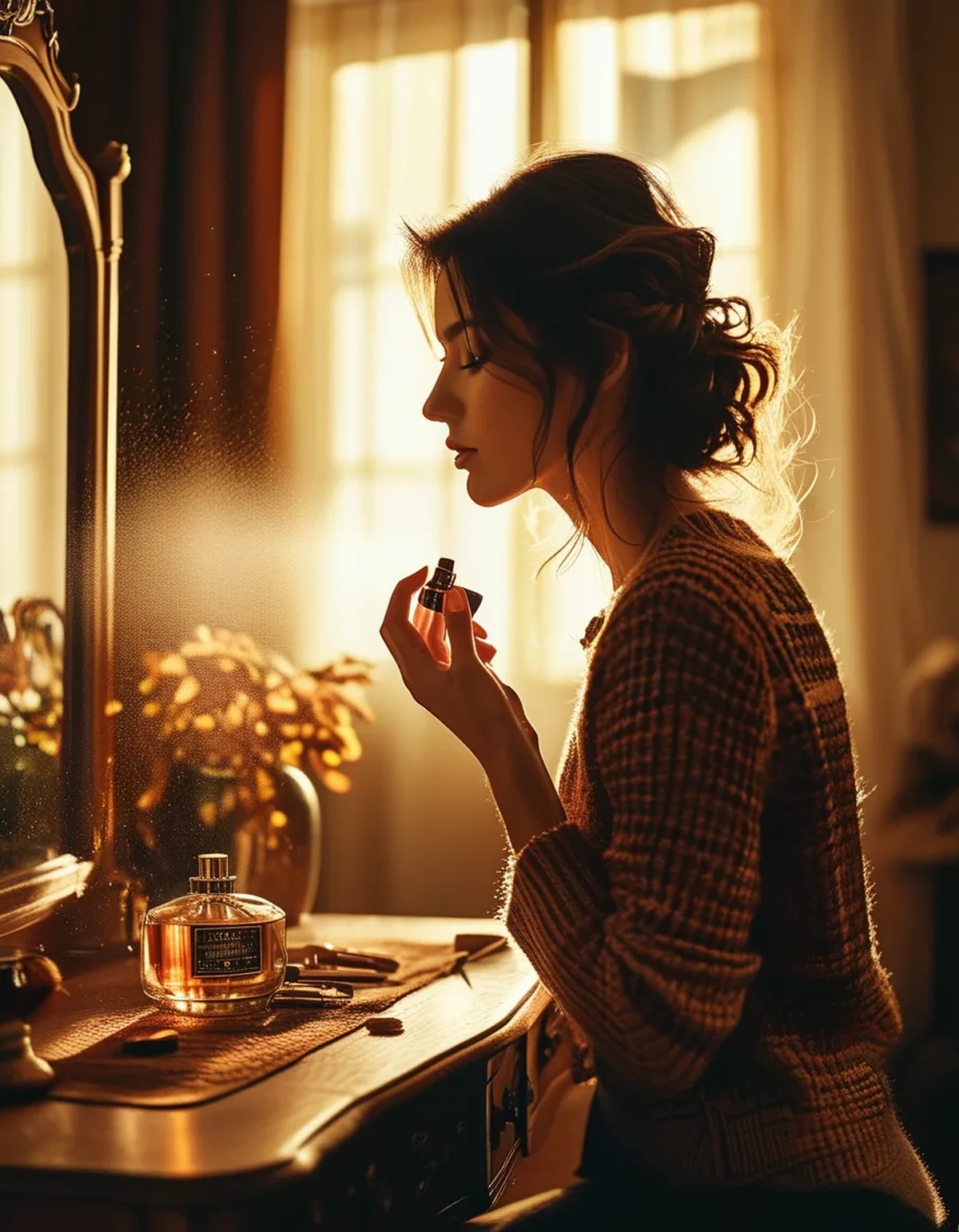
Fragrance settles on clothing as well as skin, and fabric holds it far longer than skin does — wool and cashmere particularly, because of the fibre structure. In a warm room, that stored fragrance is gently warmed and re-released throughout the day.
This is genuinely useful and it changes the arithmetic. A scarf or jumper worn for a few hours in a heated room becomes a slow-release source, which is why a fragrance can seem to reappear in the afternoon without reapplication.
It also means yesterday’s fragrance is still in today’s jumper, and the two combine into something neither of them is.
What to do: spray one thing deliberately — a scarf, a coat lining, the inside of a cuff — and let it carry the day rather than reapplying to skin. And be aware that a knitwear-heavy autumn wardrobe holds fragrance across wears, so rotating knits matters if you also rotate fragrances.
Way 5: Going in and out amplifies everything
The transition between cold outdoors and heated indoors is where the changes become most obvious.
Stepping from a cold street into a warm room raises your skin temperature by several degrees within a couple of minutes. That produces a genuine burst of projection — a warm-up bloom that is often the strongest the fragrance will be all day.
Going the other way, out into cold air, the fragrance appears to vanish almost entirely. It has not; the volatility has just dropped sharply.
So an autumn day with several transitions produces a fragrance that seems to switch on and off, which is disorienting if you are trying to judge whether you applied enough.
What to do: judge your application by the indoor bloom, not the outdoor quiet. The moment you walk into a warm room is when other people experience your fragrance most strongly, and it is the moment worth calibrating for.
And choose accordingly. Fragrances that are already heavy and sweet can become genuinely overwhelming on the indoor bloom, while brighter and greener compositions handle the transition considerably better.

FAQ: Heated Room Fragrance Questions, Answered
Should I switch to heavier fragrances in winter?
The conventional advice says yes, and indoors it frequently backfires — heavy fragrances plus still warm air plus accumulation is how people end up wearing too much. Heavier works well outdoors in cold air and less well in a heated office.
How much less should I apply indoors?
As a starting point, one spray fewer than your outdoor amount, and reassess. Ask someone you trust rather than judging by your own nose, which stopped being reliable ten minutes after application.
Why does my fragrance smell different in my flat than at work?
Different humidity, different air movement, and different room size. A well-heated small flat and an air-conditioned office are genuinely different environments for the same bottle.
Does storing perfume near a radiator matter?
A great deal. Heat degrades fragrance faster than almost anything except sunlight. A bottle on a windowsill above a radiator will noticeably change within a season — store bottles somewhere cool and dark.
Is there a fragrance type that handles heated rooms best?
Generally, compositions with some green, woody or aromatic structure hold their shape better in warm still air than very sweet or very heavy ones, which can become cloying as they accumulate.
TL;DR:
- Warm skin burns through top notes faster, so fragrances read as their base earlier than intended
- Dry heated air shortens projection, and moisturised skin is the most effective fix
- Still indoor air lets scent accumulate around you while your own nose stops registering it
- Knitwear holds and slowly re-releases fragrance, which is useful and also carries across wears
- The moment you walk from cold into a heated room is the strongest your fragrance will be all day
Apply one spray fewer indoors than you would outdoors, put it on moisturised skin, and let a scarf carry the afternoon. The bottle you already own behaves like a different fragrance once you do.
Keep Reading
This article is for general informational and styling purposes only. Fit, sizing, and product availability may vary.