5 Scent Moments in a Day and What Each One Actually Needs
Quick Answer: Fragrance performance depends on skin temperature, ambient temperature, air movement, and how close other people are - and all four change across a day. A scent that reads beautifully on a cool morning walk can be overwhelming in a warm meeting room and undetectable outdoors in the evening. The fix is not a better perfume; it is matching intensity and projection to the setting. Five moments, five different requirements.
Here is what each one actually needs.
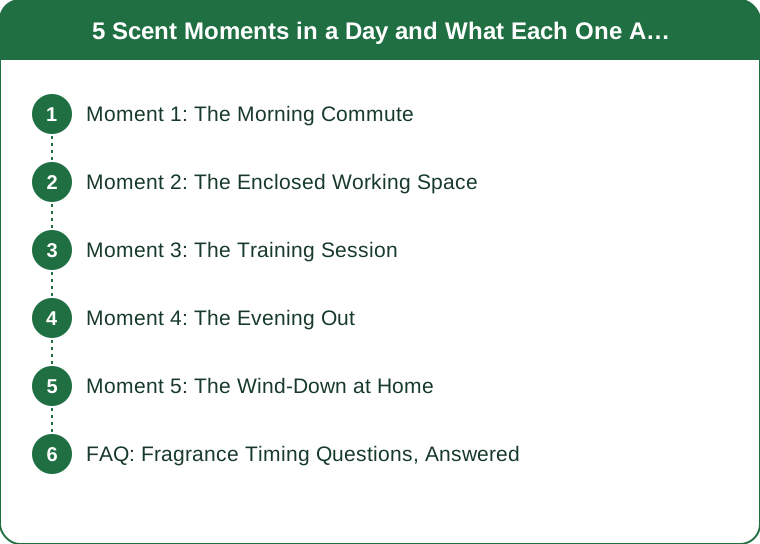
Moment 1: The Morning Commute
Cool air, movement, and variable proximity to strangers. This is the moment people most often get wrong in both directions.
Cool air suppresses projection. Fragrance volatilises more slowly at lower temperatures, so the same application that felt right in July reads as barely there in October. The instinct is to apply more - which becomes a problem the moment you step into a heated space.
And you will step into a heated space. A train, a bus, an office. Whatever you applied in cold morning air will bloom considerably once your skin warms up, which is the mechanism behind almost every over-applied commute.
What works: a moderate application of something fresh and relatively linear - citrus, light florals, clean woods. Linear scents change less as conditions change, which is exactly what you want when you are moving between temperatures.
Apply to pulse points and let it settle for a few minutes before dressing. Fragrance applied and immediately covered by layers behaves differently, and a scarf or collar holds scent far longer than skin does - useful if you want longevity, problematic if you over-apply.
The practical rule for cold mornings: apply what feels slightly too little. It will be correct by the time you are indoors and warm.
Moment 2: The Enclosed Working Space
Shared air, no movement, and people at close range for hours. This is the most constrained moment of the day.
Projection matters far more than the scent itself here. In a shared space, the consideration is whether people who did not choose your fragrance have to experience it for eight hours. Many workplaces have explicit guidance on this, and many more have implicit expectations.
Warm indoor air amplifies everything. Heated offices in autumn and winter increase projection compared to the same scent in a cool room, which is why a fragrance that worked all summer can suddenly feel like too much in October.
What works: skin scents and low-projection compositions. Soft musks, light woods, subtle florals - things that read as personal rather than as an announcement. The measure of a good office fragrance is that people notice it when close, not when they enter the room.
Apply less than you would elsewhere, and apply earlier. Applying an hour before you arrive lets the sharpest top notes burn off before you are in shared air.
And avoid reapplying at your desk. Nose blindness to your own fragrance is well established - you stop perceiving it long before anyone else does, which is why mid-afternoon reapplication is almost always more than the room needs.
Moment 3: The Training Session
Heat, sweat, movement, and shared equipment. The one moment where the answer might be nothing at all.
Heat and sweat amplify projection dramatically. Raised skin temperature increases volatilisation, so a moderate application becomes strong within twenty minutes of activity.
Fragrance also interacts with sweat. The composition genuinely changes on warm, damp skin, and not usually in a good direction - which is why a scent you love can smell wrong after a class.
What works: very little, or nothing. If you want something, a light application of something clean and simple rather than anything complex or heavy. Many people find a scented body wash or a light deodorant is sufficient.
Save the fragrance for after the shower. Applying to clean, warm skin post-training is when scent performs best all day - warm skin projects well and the shower has removed anything competing.
And be aware that hair holds scent strongly. Fragrance in hair persists through movement and warmth far longer than on skin, which makes it either a useful trick or an accidental over-application depending on your intention.
Moment 4: The Evening Out
Cool outdoor air, warm indoor venues, and close conversation. The moment with the widest range of conditions in a single event.
You will move between cold and warm repeatedly. Outside waiting, inside crowded, outside again. Anything you calibrate for one will be wrong for the other, which is why evening fragrance benefits from a composition that holds together across conditions.
Evening is where richer compositions belong. Ambers, deeper woods, spices, richer florals - these read as heavy in a warm office and appropriate in a cool evening. The setting, not the season, is what makes them work.
Apply to points that stay warm and covered. The base of the throat, behind the ears, and the wrists if they will not be exposed to cold air all night. Scent applied to skin that then gets cold stops projecting entirely.
And a scarf or coat collar carries scent beautifully in cool weather. A small application to a fabric that stays near your face outperforms a larger application to skin in cold conditions - and it is the classic autumn adjustment.
One caution about close settings: dinner, a bar, a car journey. Anything intense becomes very present at conversational distance, and the difference between memorable and overwhelming is about two sprays.
Moment 5: The Wind-Down at Home
No audience, warm indoor air, and proximity to bedtime. The moment most people ignore entirely, and the one with the clearest purpose.
This is the only moment where the scent is purely for you. No projection considerations, no setting to match. Which makes it the best place for the things you love that do not suit anywhere else.
Scent and routine reinforce each other. A consistent evening scent becomes a cue - a signal that the day’s demands are over - and that association builds with repetition. This is genuinely useful if your evenings tend to blur into your working day.
Choose something calming and low-intensity. Soft, warm, or herbal compositions. Avoid anything sharp or stimulating close to bedtime, and be aware that some people find any fragrance disruptive to sleep.
Consider the room rather than your skin. A candle, a pillow mist, or a diffuser does the same job without leaving scent on you overnight - and it treats the whole space rather than one person.
And this is where seasonal scent belongs most naturally. As evenings get darker and cooler, the warm, resinous, spiced compositions that feel excessive in daylight settle perfectly into an evening at home. It is the one moment where following the season entirely is the right call.
Across all five: the variable is the setting, not the perfume. Two or three fragrances covering different intensity ranges outperform one expensive bottle used everywhere - and the skill is matching intensity to the room, which costs nothing to learn.
FAQ: Fragrance Timing Questions, Answered
Why does my perfume smell different at work than at home?
Warm indoor air increases projection, and enclosed spaces concentrate it. The same application that is right in a cool room can be considerably too much in a heated office.
Why can I not smell my own perfume after an hour?
Nose blindness - your olfactory system adapts to a constant stimulus. Other people can still smell it, which is why reapplying because you cannot detect it usually results in too much.
Should I apply more fragrance in cold weather?
Slightly, but be careful - cool air suppresses projection outdoors while indoor heating amplifies it. Apply what feels slightly too little in the cold; it will be right once you are inside.
Where should I apply fragrance in cold weather?
Points that stay warm and covered, plus a small amount on a scarf or collar. Scent on skin that gets cold stops projecting almost entirely.
Should I wear fragrance to the gym?
Very little or nothing. Heat and sweat amplify projection substantially and can change how a composition smells. Save it for clean, warm skin after the shower.
Do I need multiple fragrances?
Two or three covering different intensity levels is far more useful than one used everywhere. The skill is matching intensity to the setting, not owning more bottles.
TL;DR:
- Fragrance performance depends on skin temperature, air temperature, air movement, and proximity to others - all of which change through the day.
- Morning commute: cool air suppresses projection but a heated train will bloom it. Apply what feels slightly too little.
- Enclosed workspace: skin scents and low projection. Apply earlier and less, and never reapply at your desk - nose blindness is real.
- Training: very little or nothing. Heat and sweat amplify projection and can change the composition entirely.
- Evening out: richer compositions belong here. Apply to warm, covered points, and use a scarf or collar in cold air.
- Wind-down at home: the one moment purely for you - and where seasonal, warm, spiced scents genuinely belong.
- Two or three fragrances at different intensities beat one expensive bottle used everywhere.
The variable is the room, not the perfume.
Keep Reading
This article is for general informational and styling purposes only. Fit, sizing, and product availability may vary.